Drone index tracks wheat mildew
KNOXVILLE, TN, July 08, 2026 /24-7PressRelease/ — A new wheat powdery mildew index (WPMI) offers a practical way to detect, quantify, and track a major fungal disease of winter wheat across multiple spatial scales. By integrating leaf-level spectroscopy, ground canopy measurements, unmanned aerial vehicle (UAV) hyperspectral imagery, and hot-spot analysis, the study provides a disease-specific tool for identifying infected areas and monitoring how wheat powdery mildew spreads or recovers within fields.
Wheat powdery mildew (WPM) is a destructive fungal disease that damages leaf tissues, weakens plant growth, and can cause severe yield losses or even crop failure. Current field diagnosis still relies heavily on expert visual inspection, which is labor-intensive, subjective, and difficult to scale. Although hyperspectral remote sensing has shown promise for crop disease detection, many existing vegetation indices (VIs) were developed for general pigment, biomass, or stress monitoring rather than disease-specific pathogen–host responses. Machine-learning methods can also require large, high-quality training datasets. Due to these challenges, in-depth research is needed to develop a specific, stable, and scalable method for WPM detection from ground to unmanned aerial vehicle (UAV) scales.
A research team from the Key Lab of Smart Agriculture System, Ministry of Education, China Agricultural University; the Information Technology Research Center, Beijing Academy of Agriculture and Forestry Sciences; the Institute of Plant Protection, Chinese Academy of Agricultural Sciences; and the College of Land Science and Technology, China Agricultural University, reported (DOI: 10.34133/remotesensing.0955) the study in Journal of Remote Sensing on April 10, 2026. The study addresses the need for rapid, field-scale monitoring of WPM in smallholder farms, where disease spread can be spatially uneven and difficult to capture through manual scouting alone.
The study developed two forms of WPMI: WPMIG = (R760 − R554)/(R661 + R554) and WPMIR = (R760 − R661)/(R661 + R554). These indices were designed from disease-sensitive bands in the green, red, and near-infrared (NIR) regions. Compared with traditional VIs, wheat powdery mildew index (WPMI) more consistently distinguished healthy and infected wheat and better quantified disease index (DI) across leaf, ground canopy, and UAV canopy scales. WPMIG showed particularly strong performance and was selected for UAV-based hot-spot analysis to reveal potential infection and recovery areas.
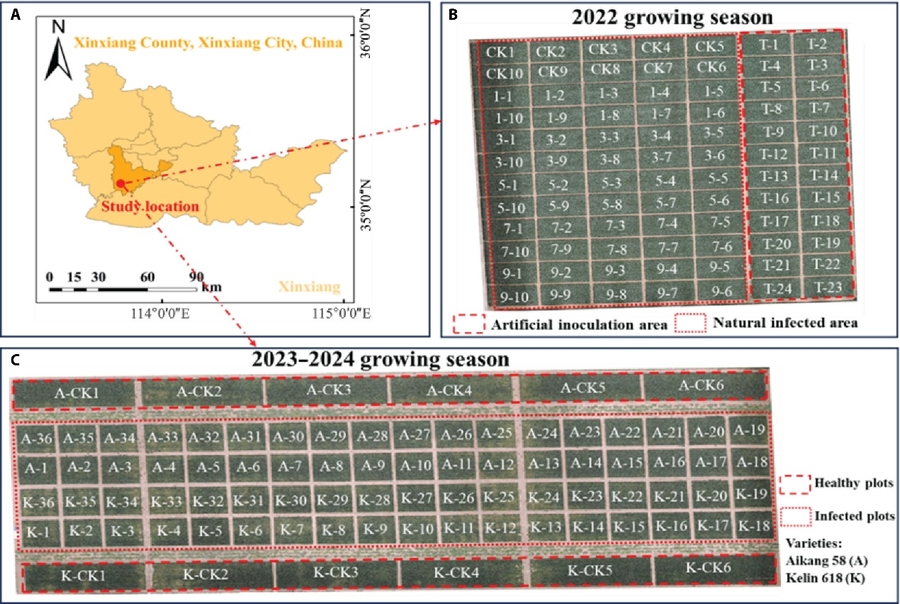
The researchers collected three years of data from greenhouse and field experiments conducted from 2022 to 2024. The dataset included 1,260 leaf spectra and 804 canopy spectra under different infection conditions, wheat varieties, and spatial scales. At the leaf scale, WPMI achieved the highest overall classification accuracy (OCA), reaching 85% and 86% for WPMIG and WPMIR, respectively, in the 2022 greenhouse experiment. In field conditions, the two indices achieved 81% and 80% accuracy in 2023, and 80% and 81% in 2024. For disease severity estimation, WPMIG reached R² values of 0.55 to 0.93 at the ground scale and 0.48 to 0.90 at the UAV scale. The UAV-derived WPMIG maps, combined with Getis–Ord Gᵢ* hot-spot analysis, identified clusters of likely infection and tracked spatiotemporal changes across smallholder plots over three growing seasons.
The researchers noted that a disease-specific spectral index can move crop disease monitoring beyond simple image comparison. By linking UAV hyperspectral imagery with spatial hot-spot analysis, the method can help reveal where WPM is emerging, expanding, or declining, offering a potential basis for earlier warning and more targeted disease management.
Leaf spectra were collected using a handheld hyperspectral camera, while canopy spectra were acquired using a ground spectrometer and a DJI M600 UAV equipped with a Pika L hyperspectral camera. Linear discriminant analysis (LDA) was used to select sensitive bands and evaluate classification performance. DI was measured through field surveys following national standards. Linear regression assessed the relationship between WPMI and DI, while hot-spot analysis mapped spatial infection clusters from UAV imagery.
With further validation across regions, wheat varieties, sensors, and disease conditions, WPMI-based UAV monitoring could support precision plant protection and early warning systems for wheat production. The approach may help farmers identify disease hot spots before severe outbreaks occur, reduce unnecessary pesticide use, and improve field-level decision-making. More broadly, this strategy provides a framework for developing disease-specific remote sensing indices for other crop–pathogen systems, contributing to smarter and more resilient agricultural monitoring.
References
DOI
10.34133/remotesensing.0955
Original Source URL
https://spj.science.org/doi/10.34133/remotesensing.0955
Funding information
This work was supported by the National Key Research and Development Program (Grant No. 2021YFD2000103), the National Natural Science Fund (Grant No. 32371995), the China Postdoctoral Science Foundation (2025M782465), the Henan Science and Technology Breakthrough Program (262102110349), the Central Guidance Fund for Local Scientific and Technological Development Projects in Inner Mongolia (2024ZY0145), the 2115 Talent Development Program of China Agricultural University, the Key Research and Development Program of Shandong Province (2022CXGC020708), and the Training Reform Project of College (SZ-2024-02).
About Journal of Remote Sensing
The Journal of Remote Sensing, an online-only Open Access journal published in association with AIR-CAS, promotes the theory, science, and technology of remote sensing, as well as interdisciplinary research within earth and information science.
Chuanlink Innovations, where revolutionary ideas meet their true potential. Our name, rooted in the essence of transmission and connection, reflects our commitment to fostering innovation and facilitating the journey of ideas from inception to realization.
Related Link:
http://chuanlink-innovations.com
—
For the original version of this press release, please visit 24-7PressRelease.com here
Legal Disclaimer: This article was provided by an independent third-party content provider. Kyrion Media makes no warranties or representations in connection with it. All information is provided “as is” without warranty of any kind. This content may not have been reviewed by our editorial staff and is published automatically. The views expressed in this article are those of the author and do not necessarily reflect the views of Kyrion Media. All trademarks are the property of their respective owners. If you are affiliated with this article and would like it removed, please contact retract@kyrionmedia.com.