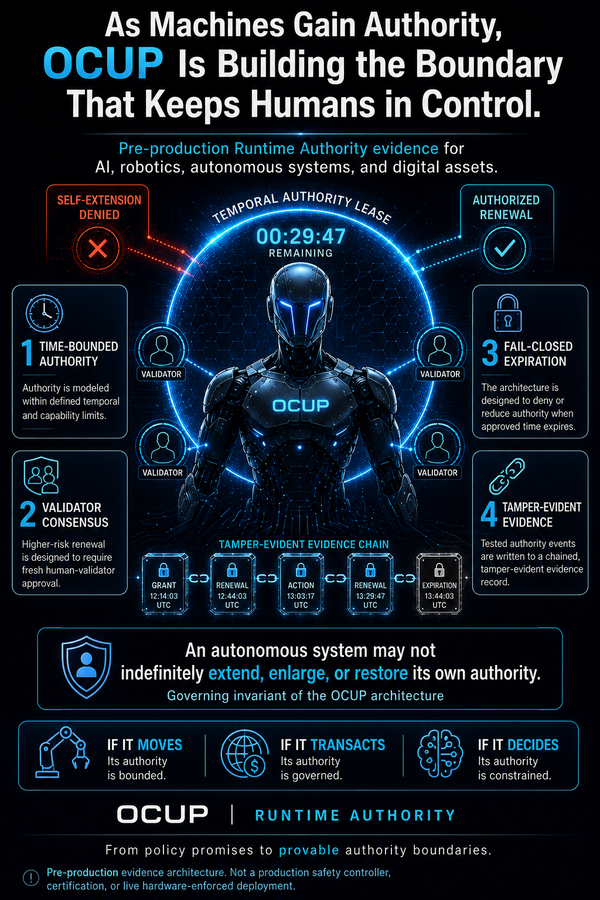
CHICAGO, IL, July 14, 2026 /24-7PressRelease/ — Temporal Authority Systems PBC today introduced OCUP, the One Chip Unified Protocol, a pre-production Runtime Authority evidence architecture being developed to establish time-bounded authority leases, multi-party validator consensus, fail-closed boundaries, and tamper-evident evidence for autonomous systems.
OCUP’s current commercial offering is a paid benchmark, audit, and technical due-diligence program. It is not yet a production safety controller, live distributed validator network, hardware-enforced deployment, insurance approval, or third-party certification.
The program is designed to help organizations test a foundational question before live deployment:
Can an autonomous system be prevented from indefinitely extending, enlarging, or restoring its own operational authority and can the resulting grant, denial, expiration, degradation, quarantine, or recovery decision be proven?
Temporal Authority Systems PBC is initially opening paid pilot participation to insurers, technical underwriting teams, robotics manufacturers, autonomous fleet operators, and strategic evaluators.
The broader architecture may also have future applications across enterprise AI, financial infrastructure, cloud platforms, defense, aerospace, and other high-consequence autonomous environments.
A New Category: Runtime Authority
Most existing systems focus on identity, access, monitoring, cybersecurity, model behavior, or post-incident logging.
OCUP addresses a different layer.
Authentication asks who or what is making a request.
Access control asks whether that actor has permission.
Observability records what the system reports.
Runtime Authority asks whether that permission should still exist now, under current conditions, for this specific capability.
OCUP is being developed to govern that authority through temporal boundaries, validator-mediated decisions, fail-closed behavior, and evidence-producing control events.
Under the OCUP model:
• authority is limited in time;
• high-risk actions may require stronger validator consensus;
• loss of communication cannot expand authority;
• stale or replayed approvals cannot restore authority;
• lease expiration produces denial or bounded degradation;
• critical recovery requires fresh authorization;
• autonomous systems cannot approve their own indefinite continuation;
• material authority events generate tamper-evident evidence.
The current pilot program models and tests these authority behaviors under bounded, deterministic scenarios.
The current pre-production evidence harness is implemented in Rust to support deterministic execution, memory-safe systems development, reproducible benchmark testing, and tamper-evident audit generation. It is a software reference implementation, not yet a production hardware-enforcement deployment.
From “Trust the System” to “Prove the Boundary”
As autonomous systems move into factories, roads, warehouses, financial networks, cloud platforms, infrastructure, and human-shared environments, organizations face growing questions around liability, insurability, technical due diligence, operational continuity, and regulatory accountability.
Traditional logs may show what software reports after an event.
OCUP’s Runtime Authority model is designed to produce a structured record of the authority decision itself.
That record may include:
• the identity of the governed system;
• the authority lease in effect;
• the capability being requested;
• the applicable time boundary;
• validator participation and quorum state;
• the reason for approval or denial;
• the behavior following expiration or loss of quorum;
• evidence associated with degradation, quarantine, and recovery.
The objective is to create a clearer technical basis for underwriters, risk teams, engineers, regulators, auditors, and strategic partners evaluating autonomous-system behavior.
The Signature Test: Self-Extension Denial
At the center of the OCUP pilot program is a benchmark designed to test one of the most consequential questions in autonomous-system governance:
Self-Extension Denial Proof
The test generates a deterministic evidence record showing that an autonomous system attempted to continue or enlarge its authority beyond an authorized temporal boundary—and that the request was denied without relying on the system’s voluntary compliance.
Additional benchmark families include:
• lease expiration and fail-closed behavior;
• validator-quorum loss;
• network partition and communication failure;
• stale approval and replay rejection;
• quarantine initiation and release;
• phased recovery;
• deterministic replay;
• evidence-chain integrity;
• gradual capability reduction under deteriorating conditions.
These benchmarks are intended to help organizations examine how authority behaves under pressure before production deployment.
Paid Pilots Now Opening
OCUP’s paid pilots are structured as pre-production benchmark, audit, and technical due-diligence engagements.
They are not production safety certifications, insurance approvals, or live autonomous control deployments.
The program currently includes three commercial levels:
Reference Evidence Pilot
A 90-day engagement for organizations seeking a company-specific Runtime Authority Evidence Report, standard benchmark runs, validator records, lease-expiration evidence, denial events, and an executive closeout briefing.
Integration Evidence Pilot
A 90- to 120-day engagement incorporating client-specific scenarios, telemetry mapping, adversarial test design, underwriting or engineering questions, and production-readiness findings.
Strategic Anchor Program
A 120- to 180-day engagement for major industry participants seeking custom benchmark families, multi-system or fleet scenarios, distributed-validator planning, HSM and secure-enforcement mapping, and a longer-term integration and licensing roadmap.
The operating model is direct:
pilot.ocup.ai runs the challenge. evidence.ocup.ai proves what happened.
Each engagement is designed to convert tested autonomous-system authority behavior into a commercially usable evidence package.
Built for the Industries Carrying Autonomous Risk
For insurers, the immediate question is whether autonomous risk can be observed, benchmarked, and priced with greater technical confidence.
For robotics companies, the question is what authority remains during network loss, sensor uncertainty, subsystem failure, or delayed coordination.
For autonomous fleets, the question is whether degraded conditions cause capabilities to narrow safely rather than expand unpredictably.
For enterprise AI platforms, the question is whether agents can be prevented from indefinitely renewing credentials, permissions, or operational scope.
For financial institutions, the question is whether high-risk digital actions can be contained pending fresh consensus.
For defense and aerospace systems, the question is whether machine execution can remain subordinate to authenticated command authority.
OCUP is built around the proposition that these are not separate problems.
They are manifestations of the same missing infrastructure layer:
Runtime Authority.
Preserving Humanity’s Seat at the Table
Temporal Authority Systems PBC was formed around a long-term public-benefit mission: to preserve humanity’s seat at the table as autonomous systems gain greater operational power.
That does not mean requiring a person to manually approve every machine action.
It means establishing a boundary that machines do not control.
It means ensuring that temporary authority cannot be silently converted into indefinite authority.
It means keeping human institutions structurally relevant even when machines operate at speeds no human can continuously supervise.
And it means producing evidence strong enough for institutions to evaluate whether those boundaries held under the tested conditions.
“Human control cannot depend solely on whether an autonomous system chooses to obey,” said Max Davis, Founder and CEO of Temporal Authority Systems PBC. “The boundary must exist outside the system’s discretion. OCUP is being built to make that boundary time-bounded, validator-governed, fail-closed, and provable. Our current pilot program is designed to produce the evidence needed to test that proposition before production deployment.”
From Evidence to Infrastructure
OCUP’s current paid offering is intentionally pre-production.
The immediate goal is to establish benchmark evidence, client-specific findings, technical credibility, and commercial records across realistic operating scenarios.
The longer-term path includes:
• HSM-backed key custody;
• secure elements and hardware enforcement;
• trusted monotonic time and state;
• distributed validator networks;
• remote attestation;
• production telemetry adapters;
• certified evidence formats;
• insurer and regulator acceptance;
• sector-specific Runtime Authority standards;
• integration and licensing across autonomous-system ecosystems.
Early pilot participants may help shape the benchmark families, evidence requirements, integration models, and commercial standards that define this emerging category.
An Invitation to Industry
Temporal Authority Systems PBC is inviting a limited number of insurers, robotics manufacturers, autonomous fleet operators, technical underwriting teams, and strategic evaluators to participate in the first OCUP paid pilot cohort.
The invitation is not to purchase a finished production safety system.
It is to test a foundational proposition:
Before autonomous systems are trusted with expanding power, industry should be able to prove where their authority ends.
Organizations interested in evaluating OCUP’s Runtime Authority Evidence Pilots can visit:
OCUP.ai
pilot.OCUP.ai
evidence.OCUP.ai
About Temporal Authority Systems PBC
Temporal Authority Systems PBC is developing OCUP, the One Chip Unified Protocol, as a Runtime Authority architecture for autonomous AI, robotics, digital assets, and machine-operated systems.
OCUP combines temporal authority leases, multi-party validator consensus, fail-closed boundaries, and tamper-evident evidence to help test whether autonomous systems remain inside defined, human-governed authority limits.
Temporal Authority Systems PBC is owned by DigiPie International PBC and operates within the governance and standards framework of the Better World Regulatory Coalition Inc. (BWRCI), which serves as the self-regulatory and public-interest governance umbrella for both organizations.
The company’s public-benefit mission is to preserve humanity’s seat at the table as autonomous systems assume greater responsibility across the global economy.
—
For the original version of this press release, please visit 24-7PressRelease.com here
Legal Disclaimer: The content on this page is syndicated from independent third-party providers. Kyrion Media makes no warranties or representations regarding the accuracy, completeness, legality, or reliability of the information, including text, images, videos, or licenses. If you are affiliated with this content or have any complaints, copyright concerns, or requests for removal, please contact us at retract@kyrionmedia.com with the specific URL of the content in question. We will review and address valid requests promptly.